

Test Interface Parts

Test Sockets & Contact Fingers

The parts that touch every device you test. Contact fingers, test and burn-in sockets, pogo and Kelvin pins, and load boards, matched to your package and your handler.

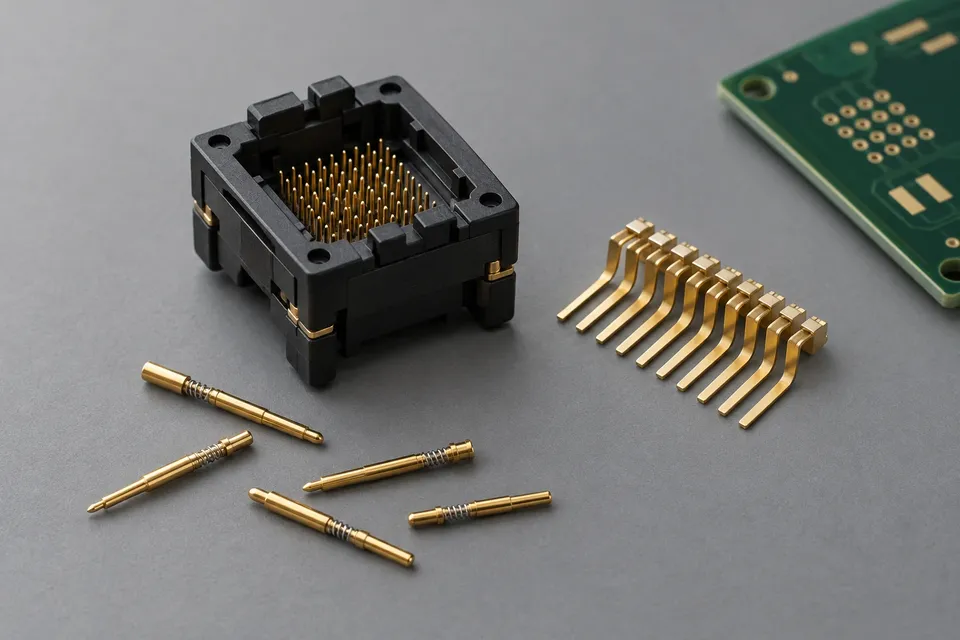
Open-top test socket, a row of gold contact fingers and spring pogo pins on an anti-static mat

Contact Fingers

Replacement contact fingers for gravity-feed, turret and pick-and-place test handlers, built to match your device package.

Ask about contact fingers
Contact Fingers specifications
PackagesPower packages such as TO-247 and HV-T2PAK, fine-pitch TSSOP, and others on request
Built fromYour used sample or drawing
StylesContact fingers or cantilever pins
ContactBeCu and hard-gold plating

Test & Burn-In Sockets

Production test sockets and burn-in sockets for packaged devices. Send a worn socket, a drawing or the socket part number and we check whether it can be matched.

Ask about sockets
Test & Burn-In Sockets specifications
TypesProduction test sockets and burn-in / reliability sockets
PitchDown to 0.3mm fine-pitch devices
MatchingFrom a sample, drawing or socket part number

Pogo Pins & Kelvin Pins

Spring probe (pogo) pins and Kelvin pins for sockets and load boards. A Kelvin pin gives each lead separate force and sense contacts, for accurate low-resistance and power-device measurement.

Ask about pins
Pogo Pins & Kelvin Pins specifications
TypesPogo pins, Kelvin pins and high-frequency elastomeric contactors
LifeRated for > 500,000 actuations
CustomPin designed to your electrical and mechanical spec

Load Boards (DIB)

Load boards, also called device interface boards (DIB), connect your tester to the socket or handler. Built for your tester, handler and package.

Ask about load boards
Load Boards (DIB) specifications
FitsThe tester and handler docking you specify
IncludesSocket and contactor fit-up on the board
We needTester model, handler, package and pin count

How ordering works

  1. Step 1

    Send what you have

    A used sample, a drawing, or the part number of the socket or finger you run today.

  2. Step 2

    We check fit

    We measure the sample or review the drawing and confirm whether it can be made or matched.

  3. Step 3

    You get a quote

    Price, minimum order and lead time. New custom parts may need a first tooling run before repeat orders.

Have a worn part on the line?

Tell us the package and the handler or tester it runs on. A photo or part number is enough to start.

Submit Technical RFQ